Reading time: 15 minutes
[Written on December 14th, 2020]
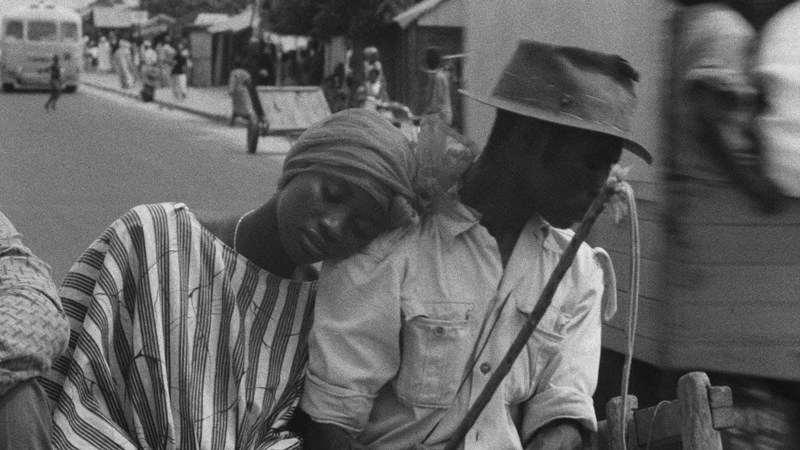
(Borom Sarret by Ousmane Sembène)
Theorists Solanas & Getino are the authors of the manifesto ‘Towards a Third Cinema’ published in 1983. In this lengthy document, they lay out the social, political, historical and economic clashes between the existing Cinemas (they name them First and Second Cinema and refer directly to the Hollywood cinema and the European style of ‘Auteur cinema’) and nations who have been impacted by neo-colonization such as South American and sub-Saharan African countries. In this manifesto, they build the groundwork for a new approach to cinema called Third Cinema, more fit for these countries’ overall situations, and explain what this entails specifically. In this article, I wish to contemplate one of their main ideas, that a film could operate as a ‘detonator or pretext’ through looking at the late Senegalese filmmaker Ousmane Sembène’s film Borom Sarret (1963), a film about a cart-driver in Dakar, Senegal.
Solanas & Getino link culture and cinema very closely. They begin their assessment by looking at third world countries’ social and political situation in reference to the existing Cinemas of the world. They bring up the ideas of ‘subversion’ and the need for the ‘decolonization of culture’. They establish an understanding that their cinema will never truly become theirs if they can’t free themselves from foreign influence. They need a culture of subversion that will in their terms then ‘carry […] a cinema of subversion’, a cinema that tells the crude reality of their world to the people that are a living part of it.
I believe that these concepts are particularly vibrant in Sembène’s film. Borom Sarret has a profound insider perspective. In other words, it is created from the psychological, moral and cultural point of view of the subjects in the story. The film is centred on a cart-driver who picks up and drops off people around the city, reflects on his encounters and surroundings, his work, his culture, his family and constantly questions himself and his life situation. Sembène embraces Solanas & Getino’s idea of the ‘naked reality’ of things. The mundanity and repetitiveness of the man’s actions reveal the world and the people that surround him without filter. Thus, the experience is as if the viewer is sitting in the cart amongst the numerous different passengers for a day: driving through the real streets of Dakar, observing the city as it is and confronting the reality of the cart driver’s life.
Something should be said about the dubbing/voiceover that creates the effect that both the cart driver’s spoken words as well as his unspoken thoughts blend and become one. When the man prays or when he thanks his wife for giving him food, it isn’t clear if the man is actually speaking or if a voiceover allows us to hear his thoughts. This discrete and perhaps purposeful confusion ads to the insider perspective of the film. The cart driver’s real-life conversations and personal reflections become exposed to the viewer. It is almost as if Sembène’s consciousness (the writer) and the cart-driver’s consciousness (the speaker), join together to shape a truly subjective depiction of the world. The internal and the external meet to showcase the deeply complex communication and interplay between thoughts and the spoken word, the often-ambivalent duality that shapes human perception and conduct. In Borom Sarret, we see the cart driver’s real-life as well as his desires and fantasies. Even if this particularity in the dubbing was revealed to be nothing more but the result of technical challenges during shooting and recording, then I would be inclined to suggest that this film is as close to the truth of reality as it attempts to be. And thus, as Solanas & Getino explain, ‘Truth, then amounts, to subversion.’, making Borom Sarret the epitome of a ‘cinema of subversion’, that has succeeded in decolonizing its culture and began to set up true grounds for new and important societal discussion. By doing this, Borom Sarret becomes something like the tool, and therefore a pretext for provoking a change in society.
Sembène combines both the ‘predictable’ and the ‘unpredictable’ to create a life-like narrative and a sense of naturalistic-realism in Borom Sarret. In her book World Cinema and the Ethics of Realism, Lúcia Najib presents Jacques Rancière’s concept of ‘aesthetic regime’ in reference to art criticism and the ideas of the ‘representational’ and the ‘presentational’, the former referring to a cinema that is ‘producing an impression of reality’, and the latter, one that is ‘acknowledging its own artifice’. Rancière states that ‘The aesthetic regime […] identifies the power of the work with the identity of contraries: the identity of active and passive, of thought and non-thought, of intentional and unintentional.’ I believe this study links to my ideas in two ways:
The first way concerns the way Sembène uses the medium as ‘representational’, this is what I call the ‘unpredictable’, in such that Borom Sarret is a fiction film that relies on documentary-like clips to anchor its story in reality. Sembène’s use of wide shots of the populated residential area, streets and markets, prove that sections of his film were not staged and that the people we see in the film are just regular civilians. There is unpredictability because these shots were not staged. Thus, at times, Sembène accepts to do nothing more but capture life, make an ‘impression of reality’ as it is, and how it shows itself to him, inherently accepting that an aspect of the Borom Sarret’s reality is exposing, like in a documentary, real-life’s reality and that’s it.
The second way concerns the ‘presentational’, this is what I call the ‘predictable’, and this concerns at once the staging of the narrative and the narrative itself. The narrative in Borom Sarret takes place over one day in a linear and chronological fashion. However, scenes feel somewhat fragmented (but in a French New Wave inspired manner) as the mise-en-scène feels mechanical, the acting is very performative and could sound off to some, and as previously mentioned the voiceover is quite intriguing. This said, I believe this is how Sembène succeeds in making what Solanas and Getino would call a ‘pretext’ film: a film that acknowledges its belonging to cinema but doesn’t attract attention to itself, but rather like a bomb ‘detonates’, destroying form, cinematic conventions, pre-defined social-political notions before disseminating all the urgency for the fixing of real societal issues, like burning pieces that are waiting to be cleaned up after. Mike Wayne goes as far as saying that this constitutes ‘the great advantage of Third Cinema’ as he states that this type of film is more interested in the ‘dialectical’ than with ‘reinvent[ing] cinema from scratch’. Furthermore, the character of the cart driver epitomizes the ‘predictable’ through staging, he is the literal conductor of Borom Sarret’s storyline. This notion of predictability constitutes the creative intentions, meanings and messages, of the author, all the while in this case, making a case to remind the viewer that they are watching a film. I therefore believe that it is by embracing both documentary and fiction, un-staged and staged, impression of reality and recreation of reality, unpredictability and predictability, that Borom Sarret achieves a degree of realism and is able to cast light, not on ‘the film’, but on the film’s ideas.
Sembène also transforms reality through subjectivity and mise-en-scène in order to make Borom Sarret not look real, but feel real. In the film, one can seemingly be brought to perceiving the reality of life in Dakar, however the true goal is most certainly for us to understand it. In Solanas & Getino’s terms, Sembène gives ‘knowledge of a reality’ through precisely transforming that reality. Bazin’s comment on filmmakers that achieved ‘facets of phenomenal reality’ through ‘stylistic means’, told by Bordwell, is interesting in this context: […] they go beyond convention to present vital qualities characteristic of the human ‘being in the world’. I believe this also goes hand in hand with what Solanas & Getino mean when they write ‘discovery through transformation’ in reference to their idea of revolutionary cinema. Thus, I would argue Borom Sarret is as revolutionary as it gets.
As I previously mentioned, Sembène embraces the stripped-down nakedness of things, however this can only take place after he’s made some critical creative decisions. Truly, Sembène is constantly sharing an array of critiques and opinions on society through mise-en-scène. For example, when a crawling disabled beggar asks the cart driver for money, the scene’s mise-en-scène presents a powerful message on social class and poverty. The close up of the resting cart driver’s flip-flops framed against the sky puts in perspective the poverty levels and overall misery in Africa. While the cart-driver is struggling to make a living, the shots of the beggar crawling on the floor from the cart driver’s point of view spark reflections about the limitations of the medium. We can only see what we are shown and we might never be able to imagine what the true reality is. This said, I am willing to suggest that the reality as it is, in the sense of objective reality, is deeply flawed because it is fundamentally unable to express any opinion, value and motivation – Sembène reminds us that a film should always be conscious of what it is showing.
In addition to this, I believe that in such a film the what to show has no value if the how to show isn’t the driving force of the piece. This said, Borom Sarret does not feel like a Second Cinema ‘auteur film’ as the focus is not exactly on Sembène’s vision but more so on the vision itself. If anything, Sembène becomes a type of ‘militant filmmaker’ that make films that are personally engaged but not personally defined. Or let’s say that he might feel uncomfortable by the idea of ‘signature’. Instead, he is like a messenger who utilizes his capability for subjectivity to relay his world. And thanks to his particular mise-en-scène and editing, Sembène transforms his surroundings into a perceptive and meaningful reality which allows the viewer to not only discover but analyze and evaluate Borom Sarret. Mise-en-scène is also a powerful way to covertly and discretely convey ideas that go against a System, as the theorists call it. All in all, real-life reality is never obstructed with, it remains the way it is, however reality is organized, sometimes re-organized, or in Solanas & Getino’s terms, reality is ‘rectified’, so that it finds meaning that transcends the narrative and anchors itself in greater questions of social, political, cultural and historical interests.
Overall, Borom Sarret fits the idea of film as working as means to an end. This confirms further the non-auteurism of Sembène’s film and expands on Solanas & Getino’s concepts of ‘guerilla filmmaking’ and ‘militant filmmaker’ while embodying the notion of ‘pretext’ and ‘detonator’. As much as Sembène was involved in cinema as a professional filmmaker, nationally like internationally, was presumed cinephile, I have a hard time thinking that this film was made with any pure motivation to make a film for cinema.Quite the opposite, in fact the marrying of the particular form, structure and content of Borom Sarret shouts out Third Cinema. Philip Rosen identifies the idea of ‘national liberation theory’ which sees film act ‘in the interest of the people’ and I believe that this is a more accurate way of understanding Sembène’s film.
I want to relate this to Solanas & Getino writing about the spectator of Third Cinema as a spectator that has ‘made way for the actor, who sought himself in others’ because I believe this is what at the core ties Sembène’s film to this movement. The length of the film which is twenty minutes suits the nature of the risky meetings and screenings that the manifesto outlines. As discussion and debates were to be held, a short film like Borom Sarret seems to be the ideal film: sharing ideas in a short amount of time meant obstructing with a System while lowering the risks of physically being obstructed with by the authorities. This idea is even present in the film when the cart-driver gets stopped by the police in a no-cart sector of Dakar. Thus, the spectator becomes the actor and the actor becomes the spectator because they share the same life and the same desires. It is only when the internal and the external, the real and the representational, the actor and the spectator, join to form a common core that an oppressed culture can rise up to the task of claiming itself back.
Finally, the structure of the film is linear and clear but open-ended. This allows for the setting up of reflections about themes and topics that are present in the film. What the film shows meets how it shows it in a way that the story might only truly present itself as a pretext, as it does not have any clear resolutions about anything. This, because the film’s overall story and content is nothing more but a ‘slice of life’ used to tackle complex political and societal issues. Sembène is not interested in giving out answers to problems, because like everyone else, he recognises their complexity and accepts that people must discuss these ideas together, in order to implement valuable change. Borom Sarret is a film that can be interpreted in different ways but, in the context of this study and the social-political issues of Africa at the time, it might only be understood as a film that prioritises function over artistry and is willing, more often than not, to sacrifice everything it is, and could be, for the ideas it carries. – TG
Bibliography and filmography
Solanas, Getino, (1983) ‘Toward a Third Cinema: Notes and Experiences for the Development of a Cinema of Liberation in the Third World’, Edited by Chanan. M, Channel Four Television, pp. 17-27.
Borom Sarret. 1963. [film] Directed by O. Sembène. Senegal: African Film Library.
Nagib, L, (2011) ‘World Cinema and the Ethics of Realism’, A & C Black, p. 3-5
Wayne. M (2001) ‘Third Cinema as Critical Practise’ in ‘Political Film: The Dialectics of Third Cinema’, Pluto Press, p.10
Bordwell, D (1985) ‘Widescreen Aesthetics and Mise en Scene criticism’ in ‘The Velvet Light Trap, University of Texas Press, p.19
Rosen, P (2010) ‘Notes on Art Cinema and The Emergence of Sub-Saharan Film’ in ‘Glocal Art cinema: new theories and histories, Edited by Galt. R and Schoonover. K, Oxford University Press, p. 400
 Theodore Gimeno