Reading time: 10 min
[Written on the April 26th, 2021]
(Bicycle Thieves by Vittorio de Sica)
In 1949, the French critic André Bazin writes a very important and influential article in response to Vittorio De Sica’s film Bicycle Thieves (1948), a film about Antonio Ricci, a working-class man who gets his work bicycle stolen. In his article called Bicycle Thief, Bazin breaks down the theoretical and aesthetic implications of the emergence of neo-realism in reference to De Sica’s acclaimed film. Although it is absolutely worth reading the entire article and discussing it in full, the concluding lines, which I will focus on, encapsulate Bazin’s most crucial reflection: ‘Bicycle Thieves is one of the first examples of pure cinema. No more actors, no more story, no more sets, which is to say that in the perfect aesthetic illusion of reality there is no more cinema’.
In Bicycle Thieves, the nature of the representation of reality could be seen as the result of the impossibility to continue producing films, practically and conceptually, in the way that people did before World War II. This said, De Sica doesn’t exactly reject past cinematic conventions. His conceptual approach is akin to a form of archaeology; he recognizes that cinema has something fundamental to retrieve from its past self. In the same way Ricci will search for his stolen bicycle throughout the film, De Sica’s representation of reality is a quest, a search, a dig… What for? The medium’s potential for conveying truth. All that we see on screen is all that is left to see.
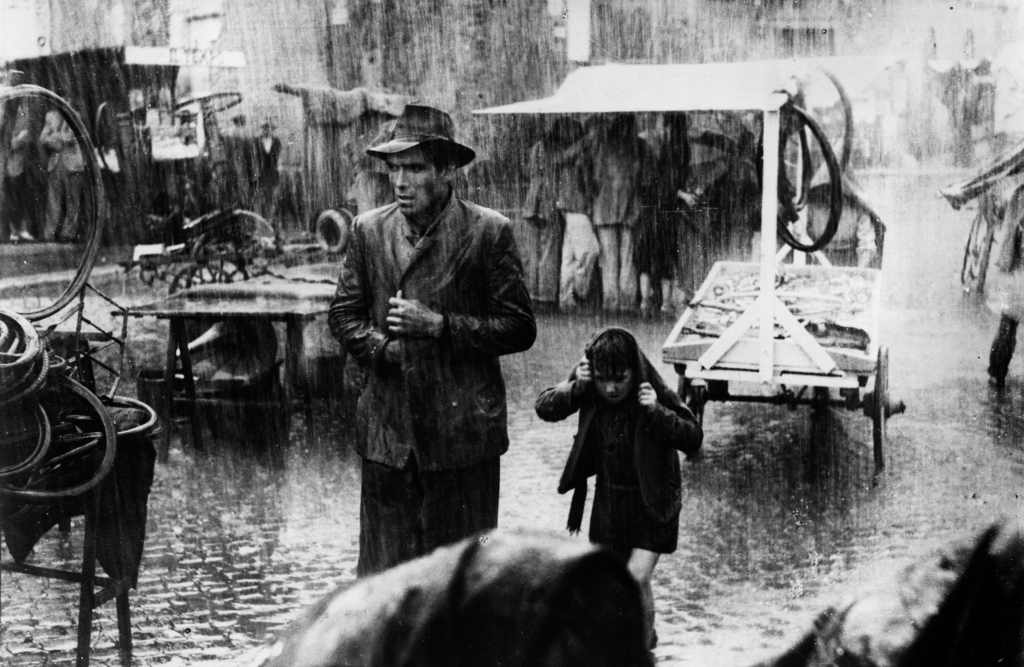
Bicycle Thieves is a film that puts everything in perspective again. Character. Story. Plot. All of it. Through the telling of a linear and chronological story, based on the life of one man (played by Lamberto Maggiorani who worked as a factory worker and was a non-professional actor at the time of his casting) and shooting entirely on location in the streets of Rome post WWII, De Sica makes a film on the human being. Simply being. Naturally, this perspective will also present, in this case, an epoch in crisis and the misery of the working-class people after the war. In this way, Bicycle Thieves becomes one of the first films to reveal the introspective and psychological capabilities of cinema and the medium’s potential for universal outreach. It is precisely through the re-assessing of the notions of cinematic reality and by formally and aesthetically redefining the fundamental roles of cinema that De Sica projects a most truthful and authentic vision of the modern world. And truly where else could cinema be found if not amid the rubble?
Bicycle Thieves is a film that unfolds in real-time. We find ourselves thrown into the story as it has already begun. We join the life of Antonio Ricci without any context, explanations or background. The film starts off with a scene in which Ricci is alerted that a group of men are talking about a job opportunity that might correspond to his profile. In the same way the viewer could be considered late to the story, Ricci is late to this meeting. The film puts the main character and the viewer on the same pedestal: just like anybody, Ricci can also miss out on an event. He’s human. We can take this one step further. Instead of Maggiorani being defined by his role in the film – conventionally a character is written in with a particular personality and other particular features that an actor needs to study – Maggionari is being held accountable by the narrative itself for the role that he plays in the real-world. Maggiorani does not perform. He is the guide of a story in which he represents at best nothing more but the image of himself. The temporality of the film makes the world of Bicycle Thieves and the world of De Sica and Maggiorani overlap. But there shouldn’t be any confusion here. The real-world and the film’s world are the same one. The narrative’s real-life temporality embodies the first contributing factor to Bazin’s idea of ‘aesthetic illusion of reality’.
Cesare Zavattini states in his essay Some Ideas on the Cinema that ‘The true function of the cinema is not to tell fables… the cinema must tell a reality as if it were a story; there must be no gap between life and what is on screen.’ (Zavattini: 1952). I think it is in part the simplicity of the plot that creates the potential for catharsis in the spectator. But it isn’t always the case. For example, when Antonio’s bike is stolen from him, the viewer experiences the same pain and sadness as him because, virtually, we have gone through the whole process of acquiring the bike too. We fear for Antonio’s bike when he asks kids to watch over it while he goes inside a building to talk with someone. We want him to notice the bike-looking shape behind the curtain in the bedroom (he never does). All in all, the viewer’s degree of identification with the character of Ricci is critical to the specific emotional responses in Bicycle Thieves. And it varies during the film. Generally, it seems that the viewer grows more and more personally invested, but not in the story nor in the character of Antonio per say, but in the film’s morals. The thought that roams discretely in our minds is something like: how can Antonio close the gap between how he is condemned to live and how he deserves to live? Ultimately, this story becomes the backdrop for reflection on the nature of people’s worth and the unfairness of the world. In line with Zavattini, De Sica is making the life of an ordinary man the tale of an extraordinary story which invites the viewer to empathize, reflect on one’s actions and make up a critical portrait of the world.
As Bazin notes, Bicycle Thieves is not shot in studio but directly on location. I believe that this fundamentally represents the most concrete aesthetic illusion of reality. It’s the real thing. In addition, the film’s setting grounds the story at once inside the physical real-world and within the historical, social and psychological reality of those spaces. One could imagine that for a Roman viewer of Bicycle Thieves living during the late 40s, the only thing that separates the real world’s reality from the one on the screen is the screen itself. This shows that there is also a documentarian aspect to the film: one that inherently challenges the fiction by relating to collective and physical understandings of the environment. Just by being staged in Rome at that time, Bicycle Thieves is charged up of significance and meaning that continually transcends Ricci’s story. However, De Sica succeeds in containing this. He positions the city of Rome precisely in terms of its history and the collective memory and meaning attached to it. The city becomes then more of a character to whom we attribute value and connect with emotionally. Bicycle Thieves is a film in which De Sica never decouples the present space from the present moment, nor the historical fact from the psychological repercussions. Ultimately, Bicycle Thieves is a film in which the authentic representation of the world is inseparable from the film’s commentary on human morality.
Although the film’s focus is on Ricci, the viewer experiences a lot of the story through the eyes of his son, Bruno, a smart but innocent kid who mimics and looks up to his father. The cinematic techniques responsible for this are the particular framing and the editing. There is an immersive style: the camera is low and often times it singles out Bruno gazing at the world around him and, more specifically, at his father. During the entirety of the film, the boy presents us with a crucial perspective on Ricci and there is the feeling of a story within a story where the little boy presents at all times, with sometimes nothing more but the look in his eyes, a complex set of implicit questionings and judgements about his father. To me, the most notable example is heart-breaking and concerns the final moments of the film. When Ricci is walking away ashamed after he got caught trying to steal a bicycle under the eyes of his son, the little boy who is walking next to him projects all of the misery and sadness of the story. Although we see that the little boy understands the gravity of the situation and knows deep down that what his father did was wrong, he nonetheless grabs his father’s hand and holds it lovingly.
Bicycle Thieves is constantly confrontingthe personal to the social. In his article “Bicycle Thieves”: A Re-reading, Frank Tomasulo claims that ‘Bicycle Thieves sets up several spatial dialectics. One major one involves the relationship between a single unit subject to a mass background or real environment in what can only be described as social shots.’ (Tomasulo: 1982) The combination of the visual formal elements (most prominently the juxtaposition of close-ups of Antonio and wide shots of the city, the people…etc) helps present, organize and curate a sequencing that is not manipulating the viewer in feeling or responding to the world, but rather helping them navigate Ricci’s tough reality. I believe that the film’s atmosphere is largely completed by the sound design, the use of natural lighting in exterior and blown out bright spotlighting in interiors to radiate the heat in visual form. The use of sound and lighting makes us feel the noise of the city and the heat of the summer. While the viewer might experience all of this subconsciously, these formal qualities are probably those which ground the film’s mise-en-scène in the aesthetic illusion of reality the most. De Sica makes great use of these more invisible tools to re-create the representation of reality in order to achieve this aesthetic. I believe that Robert Gordon resumes this brilliantly in his chapter ‘The Bicycle and Beyond’: ‘One principle seems to govern it all: the constant, textured interplay of internal layers of story, structure, image, sound and meaning and the simultaneous existence of all of these at a level of feather-light simplicity and resonant complexity.’ (Gordon: 2008)
Bicycle Thieves is perhaps one of the first films about the people as people. Their pain. Their sadness. Their powerlessness. I agree with Bazin that there is something pure about that. Formally too: no actors, no story, no sets… Nothing in Bicycle Thieves was done for cinemabut rather it was done with it. Through the stripping of cinematic conventions and the embracing of the attributes of real-life’s reality such as a real-time temporal frame, a life-like narrative and a setting in the real world, De Sica revealed the true potentially of the medium. In light of this, De Sica’s Bicycle Thieves might well be one of the most important modern films of all time.
Bibliography:
Bazin, A., 2005. ‘Bicycle Thief’ in What is cinema?. Berkeley: University of California Press, p.60
Zavattini, C. Some Ideas on the Cinema, Sight and Sound 23:2 (October-December 1953). Edited from a recorded interview published in La revista del cinema italiano 2 (December 1952). Translated by Pier Luigi Lanza. Ch. III, p.53
Tomasulo, Frank P.‘“Bicycle Thieves”: A Re-reading’. Cinema Journal, Vol. 21, No. 2. (Spring, 1982), p.5
Gordon, Robert S.C “The Bicycle and Beyond” in Bicycle Thieves. British Film Institute, 2008, pp.61-62
De Sica, V. (1948) Bicycle Thieves. [Motion Pictures] Produzioni De Sica, Ente Nazionale Industrie Cinematografiche, Joseph Burstyn & Arthur Mayer (US).
 Theodore Gimeno